In the field · the survey app
The route, the access outcome, the instrument reading, video and a voice note at every stop. It works without signal and syncs when the truck has it.
The work has three parts: finding the wells that are leaking, measuring them properly, and plugging them. Most of our effort goes into the first, and the software we built for it also produces the evidence that the second and third depend on.
State orphan lists hold records from different decades, in different formats and to different standards. Wells are often in the wrong place, and type and depth are frequently missing. We combine those lists with production history, completions, parcel ownership, aerial imagery and the location of nearby active wells, and rank each well by how likely it is to be leaking today.
We then check the ranking against what we find. Every trip includes unplanned wells checked along the route as a control, and a targeting rule that does not hold up against that control is dropped.
Widths not to scale · share of wells tested at the wellhead that were leaking, field figures October 2026
Our own software runs each field day, from the route to the well file, and since 2024 it has roughly quadrupled the number of wells we can survey in a day. It also means every measurement we take is already in a form a verifier or a buyer can read. We are now building hardware as well.
The route, the access outcome, the instrument reading, video and a voice note at every stop. It works without signal and syncs when the truck has it.
A live view of the trip from the office: pace against plan, which wells were blocked, which landowners to call, and how the planned wells compare with the control.
One file per well, holding the state data, production history, owners, the landowner agreement, and every reading with the device, duration and weather at the time.
We are building a solar-powered monitor that sits over a wellhead leak for about a week and logs how the flow changes from hour to hour, with the weather alongside. It is a screening tool rather than the official measurement, and it lets us see how steady a leak is between our visits.
The first visit is a screening survey, made with the landowner’s permission, to find out whether the well is leaking at all. If it is, and the landowner agrees to work with us, we come back for the official baseline, measured on more than one day.
On both visits we leave every valve closed and measure the gas the well is venting on its own, using a calibrated Hetek Hi-Flow sampler. Each reading is logged with the instrument, its serial number, the duration and the weather, and the survey is filmed. Repeat readings are kept, not averaged away.
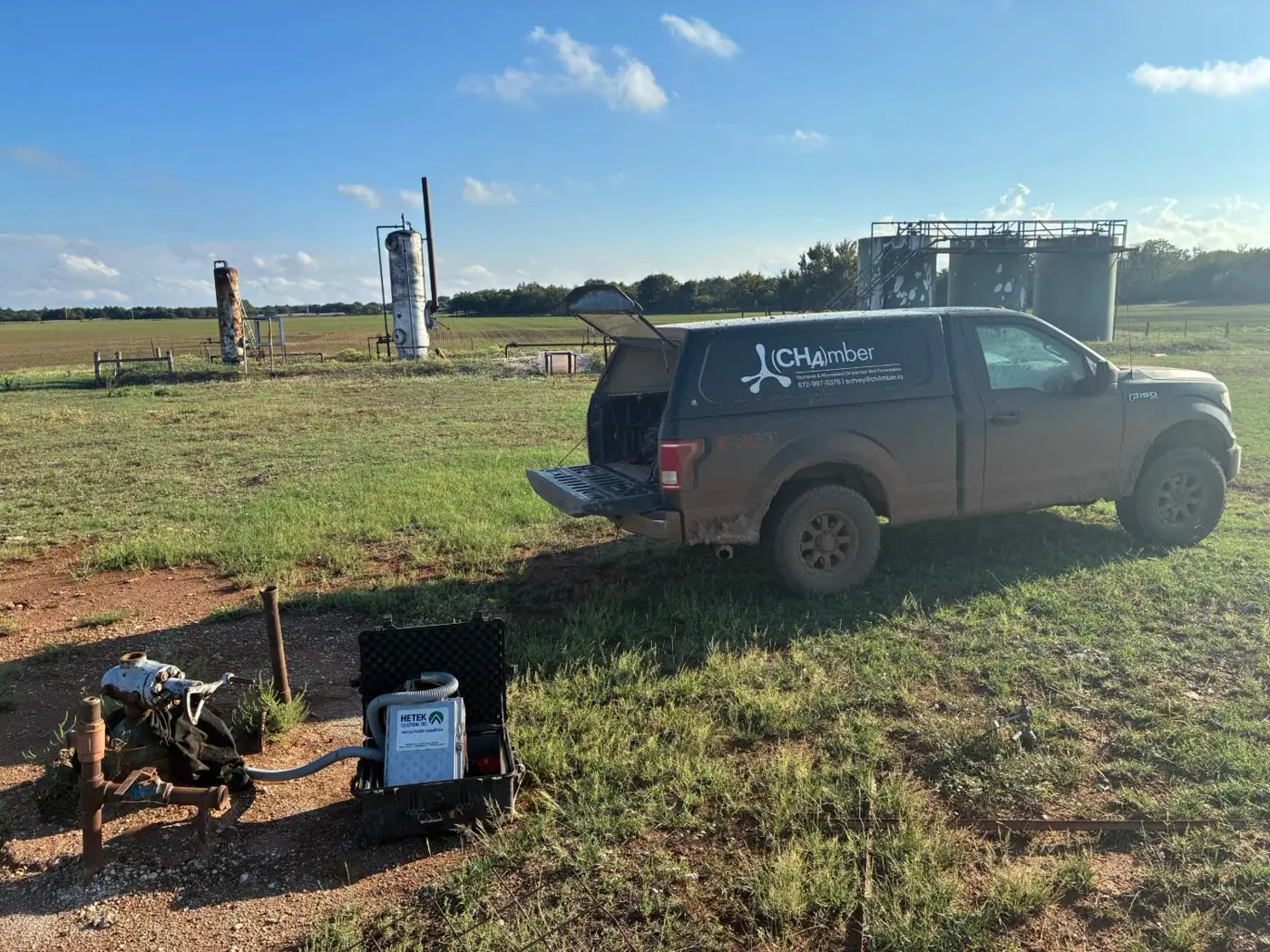
Nothing on the well is opened, turned or pressurised. A hood over the failed fitting draws the leak and the air around it into a Hi-Flow sampler, which measures methane against background over several hours, and again on another day. A full seal around a crack is hard to achieve, so if anything the reading runs low.
An isolation valve is opened and the well flows into a meter. The meter reads what the reservoir can push out at its own pressure, which is the well’s potential to emit rather than its leak, and that potential is then credited over the crediting period.
Having surveyed more than 5,000 wells, we have yet to find one leaking at anything like the rates measured on opened wells.
Becoming the operator of record makes us responsible for plugging the well permanently, so it is the last step rather than the first. We are a licensed, bonded and insured operator in Oklahoma, and the plugging itself is done by an experienced plug-and-abandon crew, with our team measuring before and after.
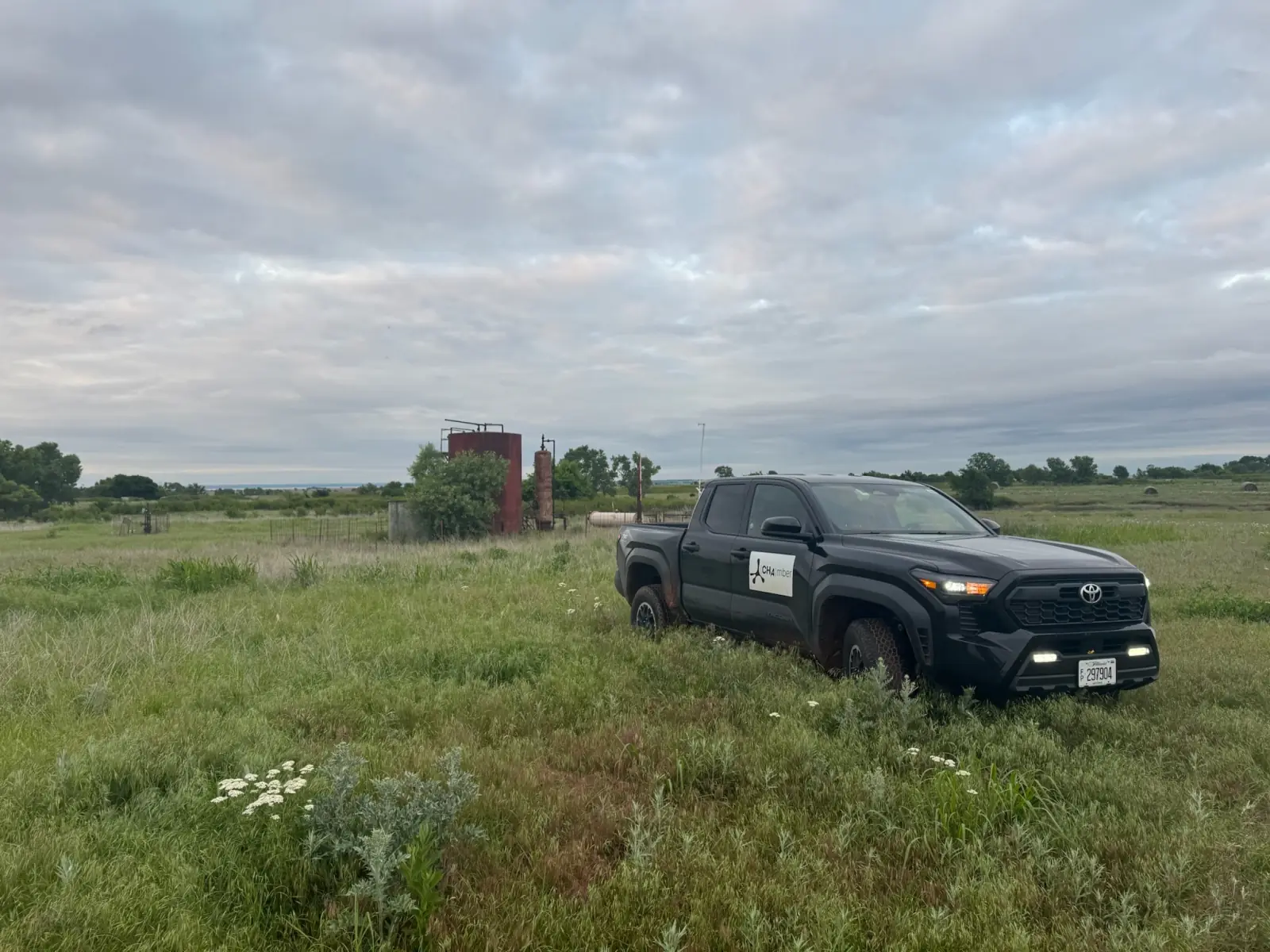
With the surface owner’s permission. Nothing is signed.
One recorded instrument, signed by every owner of the surface.
The measurements a verifier will rely on, and a check of title and records.
Filed with the Oklahoma Corporation Commission only when the rest is complete.
Plugged to state standards, the site restored, and the well checked again afterwards.
Schnitzer #2 went through every step above in 2025.