

Independent leak measurement on publicly funded plugging jobs.
If you are a plugging contractor or grantee operator, you can hire us as the measurement specialist. We check and quantify every well before it is plugged and again afterwards, change nothing on the site, and report to the program on its own form.
Our procedure is written for Texas TxMCW, Pennsylvania DEP’s MERP and orphan-well grants, and other programs that follow the DOE/NETL and DOI measurement guidelines.
Ask about an award
A reading taken after someone has opened a valve is a reading of a different well.
A program wants a before and an after. The before is only worth anything if the well was in its normal state when it was measured, so our crews never open, close or adjust anything on a program site. This follows the NETL guidelines and the measurement guidance of the Texas and Pennsylvania programs, which ask the same of the people who measure.
It also reflects a plain fact about the job: a well cannot be re-measured once it is plugged. The pre-plug measurement happens once, and it has to be one that holds up.
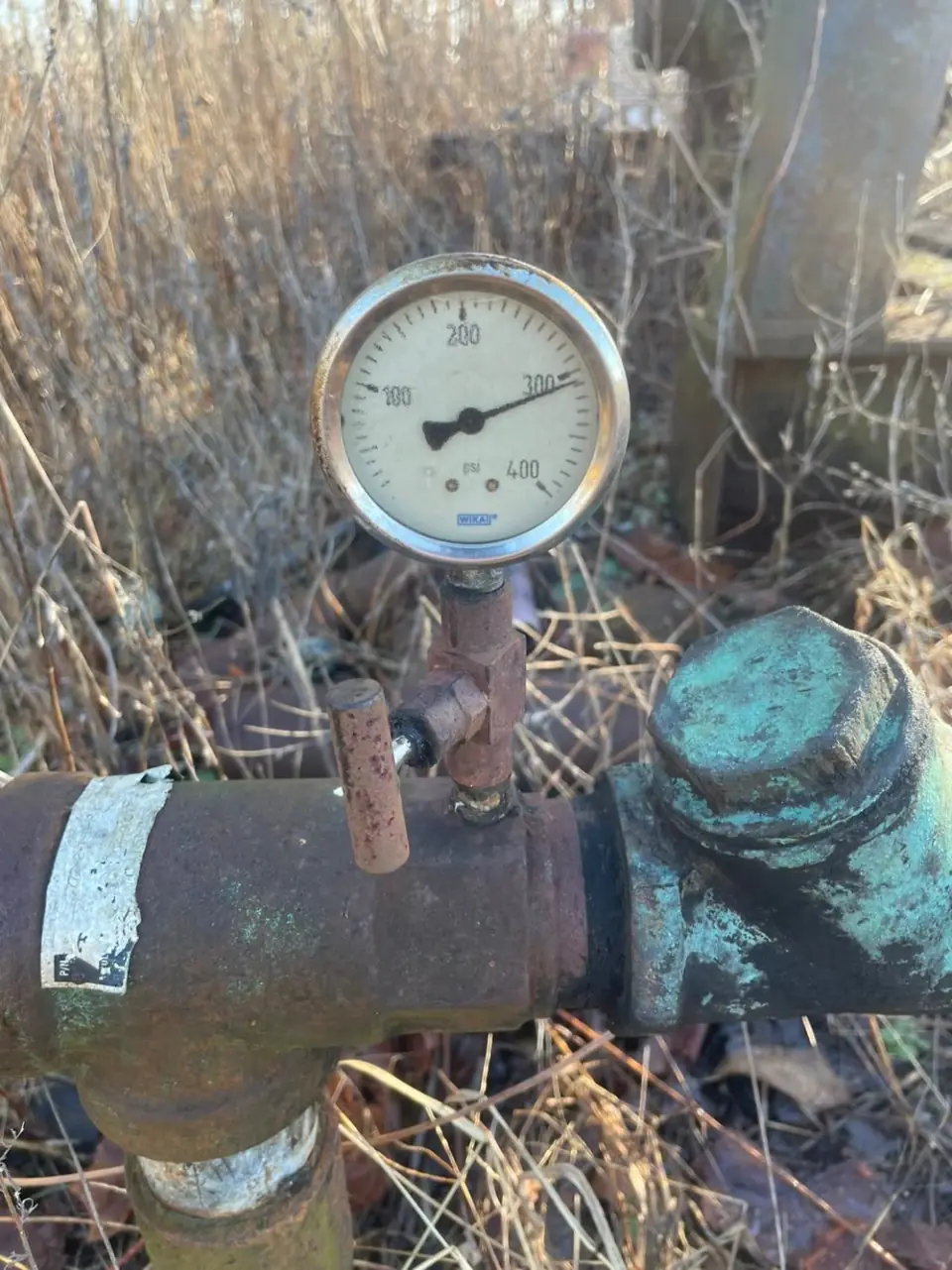
- Open, close or cycle a valveEvery valve stays as we found it. Pressure is recorded as “could not check” unless an installed gauge can be read without touching anything.
- Remove a cap, plug, flange or fittingWe measure at the surface of the component, as found.
- Connect directly to a vent, valve or portThe capture fits around the source, using the manufacturer’s attachments, a bag or antistatic wrap.
- Tighten, tape or otherwise fix a leakWe record it, and tell your site supervisor at the end of the test.
- Move or adjust tanks, separators, lines or metersWe measure them where they stand.
- Dig out a cellar or clear a buried wellheadWe record it as inaccessible, with a photo. You may expose it, and we measure after you do.
- Work while your crew is on the wellWe measure before rig-up and after the job, and wait or come back if the timing is wrong.
Check, quantify, check again, and report.
Our method for program sites. Where a program sets its own requirement, the program’s requirement applies.
Check every potential emission point
We arrive from upwind, photograph the well as found and take a background reading away from the site. Crews then check every potential emission point at the wellhead on foot, using handheld gas detection and direct observation: casing and annulus, valves, flanges and connections, caps and plugs, tanks and hatches, separators, flowlines, meters, vents, and the ground around the casing. Soap solution pinpoints a source without moving the component.
Quantify the leak rate of each point we find
At each point, the flow sampler first runs unconnected and its display is photographed. We then fit a capture around the source, with no direct connection and no backpressure, and confirm it is complete before taking readings. Each reading is recorded separately, with background before and after. We quantify with the Hetek flow sampler, following the program’s method.
Check again after the plug
Once the job is done, the same check is made at the plugged well and anything found is quantified. Timing follows the program. Where nothing is found, the record still lists every point we checked.
Report on the program’s own form
Results go to the program on its own report form, with the record behind them: photographs, instrument data files, weather and the instrument checks. We keep a copy.
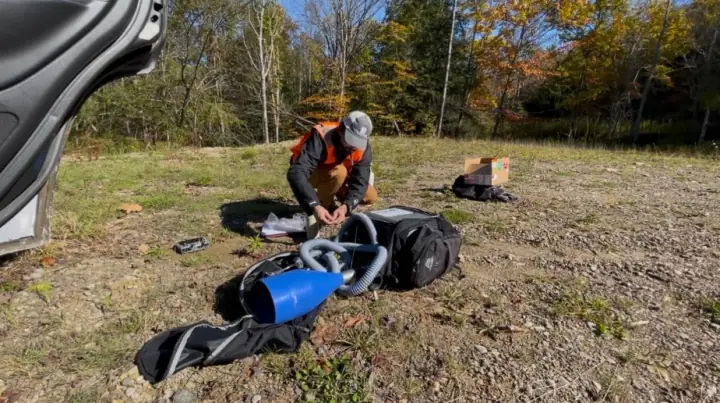
Where we cannot measure safely or properly, we say so and why. “Could not measure” is always an acceptable answer when the reason is on record. No reading is worth a risk.
A clean result is recorded, not left blank
Each point where nothing was found is logged as “not detected”, with its highest reading and the background.
A point we could not reach is never recorded as clean
Buried, unsafe or blocked points are logged as “not screened”, with the reason and a photograph.
No full capture, no clean number
If we cannot show the capture was complete, the reading is recorded as “capture not confirmed” and is not reported as a quantification.
Rain and wind can stop the test
Quantification is suspended when weather prevents a full capture, and the record says why.
The instruments we bring, and a crew trained for the site.
The flow sampler carries an in-date calibration certificate, on file before it goes to a program site, and is checked before the first test of the day and again after the last. A failed end-of-day check invalidates the tests back to the last passing check, and the contractor hears the same day.
- Quantification
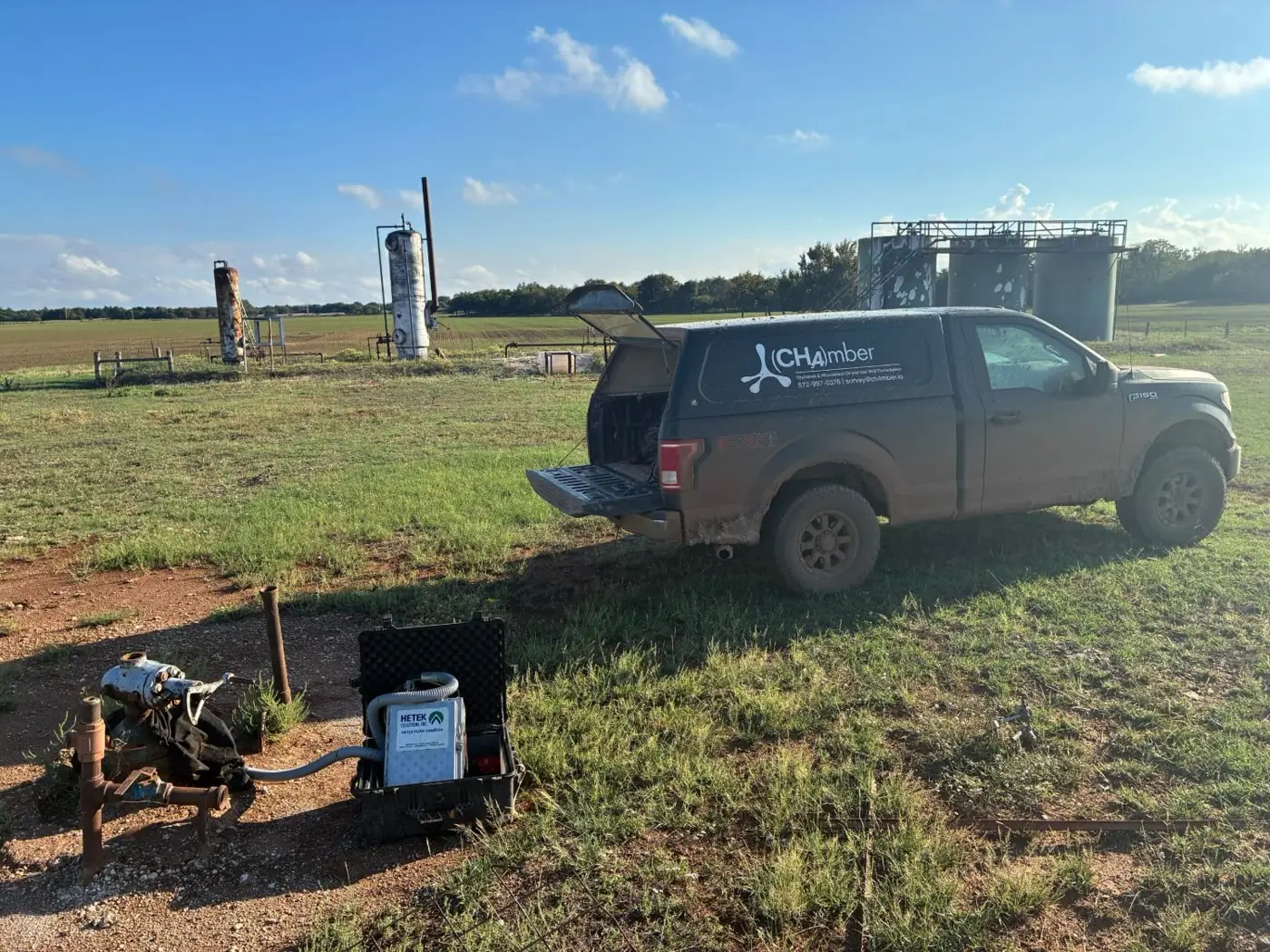
Hetek flow sampler
A blower draws the leak and the air around it through a sensor, and the instrument reports a leak rate net of background. Made by Hetek Solutions in London, Ontario, and intrinsically safe.
- Checking each point
Handheld gas detector and soap solution
For walking the site and pinpointing a source, alongside what the crew can see, hear and smell.
- Safety, not measurement
Personal gas monitor
Each person wears one, bump-tested at the start of every test day. If it alarms, the crew leaves.
Trained for the site
The field crew is trained in H₂S safety and OSHA 40-hour HAZWOPER.
Two people, always
One measures, one watches the monitors and the surroundings. Nobody enters a cellar or low-lying space alone, and either person can stop the work at any time.
A plan for each site
A written site health and safety plan, read by both before work and carried on site, and a signed tailgate meeting at every site.
Each program approves the provider’s method before work starts.
Programs set their own measurement requirements, and the provider’s method has to be approved by the program before anyone goes to a well. We do not start work on an award until it has been.
- Texas
TxMCW
TCEQ’s program for marginal conventional wells. The plugging prime or grantee operator hires the measurement firm, which files the method form (TxMCW-MIMA). TCEQ must approve it before any work order, and results go to TCEQ.
- Pennsylvania
DEP MERP and orphan-well grants
Pennsylvania DEP’s program for marginal conventional wells (MERP) and its orphan-well grants. The grant recipient hires a qualified measurement specialist, and the provider’s proposal goes to DEP on form 8000-FM-OOGM0032. Results go to DEP on its measurement report.
- Federal guidelines
DOE/NETL and DOI
The DOE/NETL Methane Measurement Guidelines for Marginal Conventional Wells, and the Department of the Interior’s orphaned-well measurement guidelines. Where an award follows them, the field procedure is the one on this page, and we complete whatever method form the program asks for.
A measurement only counts if whoever takes it has nothing riding on the answer.
So under a grant we do not measure a well we operate, hold a plugging interest in, or intend to credit. We check every award’s well list against our own wells before we mobilise, and keep a record that we did.
- operate
- hold a plugging interest in
- intend to credit
We work for the contractor or grantee who hires us, and results go to the program.
Tell us about the award and we will follow up to talk it through.
Say which program it is under and roughly how many wells it covers. We will reply with a few times to talk, and ask for the award’s well list so we can run the independence check.
If you would rather write directly, you can reach us at [email protected].