
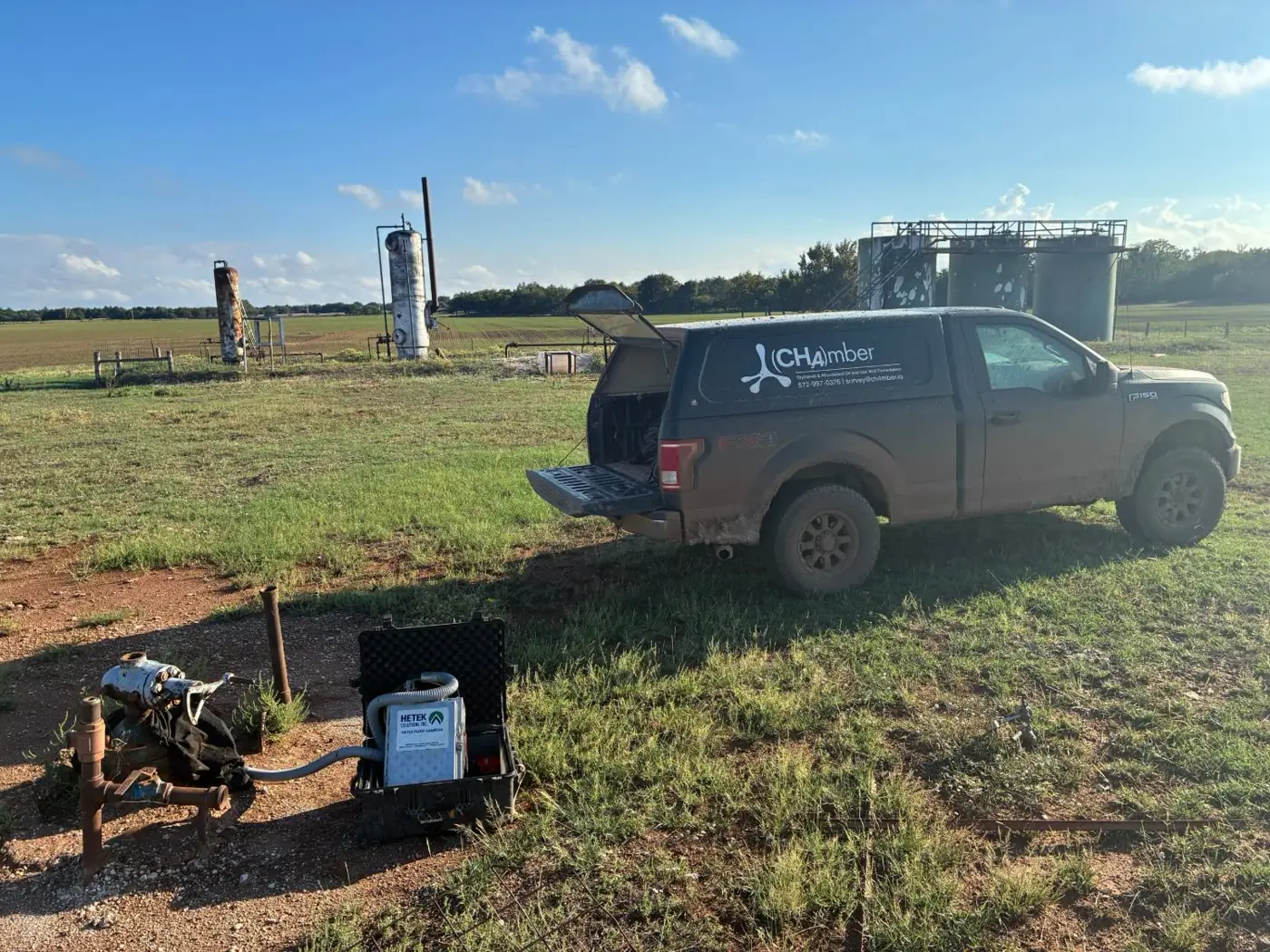
Every measurement we have made on an orphaned well has been taken as found: nothing on the well opened, turned or pressurised, and every valve left closed. We have never opened a well to test it. That choice decides more about a carbon credit than almost anything else in a project, because a leaking well and an opened well report two different quantities, and the credits are calculated from whichever one a project chose to measure.
A leak and a flow are different quantities
A leak is gas escaping through a failure in the casing or wellhead: a corroded casing head, a cracked fitting, packing that no longer seals. How much comes out depends on the pressure behind the failure and on the path through it, and on an old well that path is usually narrow and tortuous. The narrow part sets the rate.
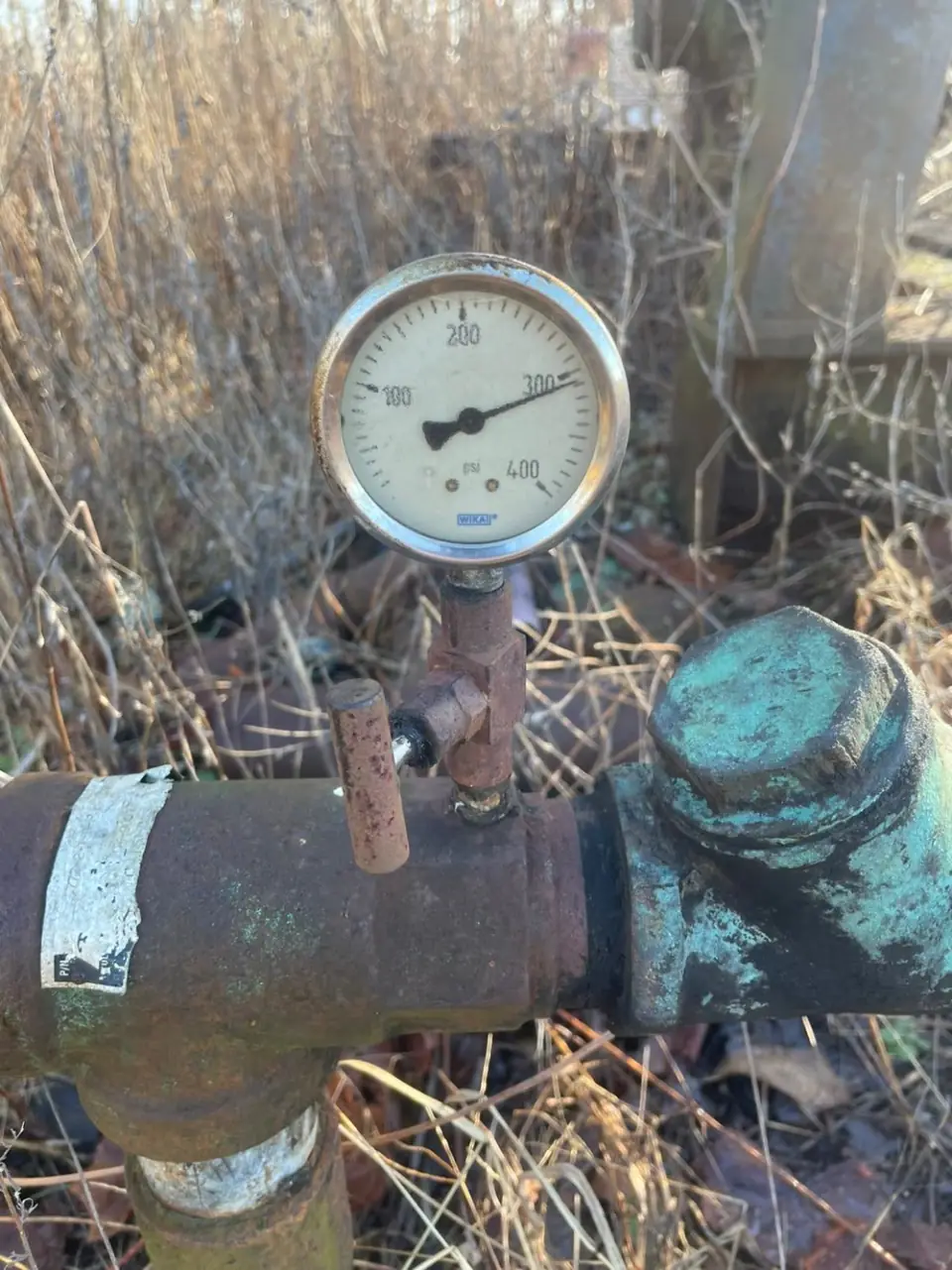
Opening the well takes that restriction away. An isolation valve is turned and the well flows through the full bore of the pipe, usually through a separator and into a meter, with the gas flared or vented beyond it. The meter then reads what the reservoir can deliver at its own pressure, which is the well's potential to emit rather than its leak. It is a legitimate measurement, the one an operator makes to decide whether a well is worth producing; it simply answers a different question.

The Environmental Defense Fund and the University of Texas at Austin draw the same line in the orphan-well issue primer they published in September 2026. They separate a current-emissions basis, which requires the well to be leaking "in its unaltered state", from an expected-emissions basis, and they note that the second "may allow for the well to be 'opened up' before emissions are measured, which can lead to a large increase in the short-term emission rate due to pressure buildup." We reviewed drafts of that primer and of its companion on marginal wells, and are thanked in both.
Credits follow whichever number was measured
Most orphan-well methods turn a starting rate into credits in the same way. The measured rate is projected across a crediting period, with some allowance for decline, and the methane is converted to a CO2 equivalent. Each step multiplies the one before it, so the credit volume moves in proportion to the starting rate. If an opened reading on a well is twenty times its leak, the credits from that well are twenty times larger, while the methane actually reaching the air has not changed at all.
Other choices widen the spread. The primer notes that three of the four orphan-well frameworks it compares credit over 20 years and one over 50, and the choice of greenhouse-gas time horizon moves the result again. Those choices are at least printed in a methodology, where a buyer can read them. Which number a baseline started from usually sits in a project's monitoring documents, and on the evidence below we believe it is the larger lever by some distance.
What the two numbers look like
Across the 72 leaking wells we have quantified, the median rate is 28 litres per minute (LPM) and the largest is 150 LPM. Each figure is the highest reading we have taken on that well, so if anything they lean high. Our wells are also chosen, not random: we go looking for the leakiest, so a typical orphaned well leaks less than our median.
28 LPMmedian as-found leak, 72 quantified wells
150 LPMlargest leak we have measured
Opened wells look very different. The ACR registry hosts the project documents behind the orphan-well projects it has issued credits to, and the largest per-well baselines in them run from about 4,300 to 7,000 LPM, measured by routing the well's gas through a separator and a meter. That is roughly 29 to 47 times the largest leak we have measured, and 150 to 250 times our median. Each of the three largest implies more methane a day than the average producing US gas well delivered in total gas in 2024, which the US Energy Information Administration puts at about 185 thousand cubic feet a day. Our read is that a well able to flow like that is, in operating terms, a producing gas well.

We went looking for a leak that large
Admittedly, on our first survey trips we were confused by the size of the leaks other developers were reporting against anything we found at the wellhead. It made sense only when a state official told us some were opening wells with flaring rigs to test them. We did not dismiss the approach outright, but we decided that before we could stand behind a direct-connect measurement we would need to find a well leaking like that in the wild. So we went surveying.
Since then we have visited more than 5,000 wells across six states and found 145 leaking. We have yet to find one leaking at anything like the rates measured on opened wells. That is a negative result, and it has limits: it does not show that such a leak cannot exist, only that none has turned up on the ground we have covered.
The as-found number has weaknesses of its own. A leak varies from hour to hour with barometric pressure and temperature, which is why we measure for several hours with a calibrated Hetek Hi-Flow sampler, come back on another day, and keep the repeat readings rather than averaging them away. A hood never seals perfectly around a crack, so some gas escapes uncaptured and the reading runs low. A current-emissions basis also has to say how long the reservoir would have kept the leak going, a question the primer leaves open for every framework and one we have to answer too.
The question behind an orphan-well credit
For a buyer, the diligence question is short. Was the credited rate measured with the well as found, or after a valve was opened? Was the gas routed through a meter run, and at what pressure? Is the baseline what the well was venting on its own, or what it could deliver? Two projects on the same physical well can answer those differently and claim very different volumes, and nothing on the face of the credit records which.
Registries are working through the same question. ACR made version 1.0 of its orphan-well methodology inactive for new projects in May 2025, leaving projects already verified and their credits unaffected, and plans a version 2.0 for 2026; we sit on the working group revising it. We are also a development partner on Isometric's orphaned-well protocol. Step by step, the way we measure is on How we work.