
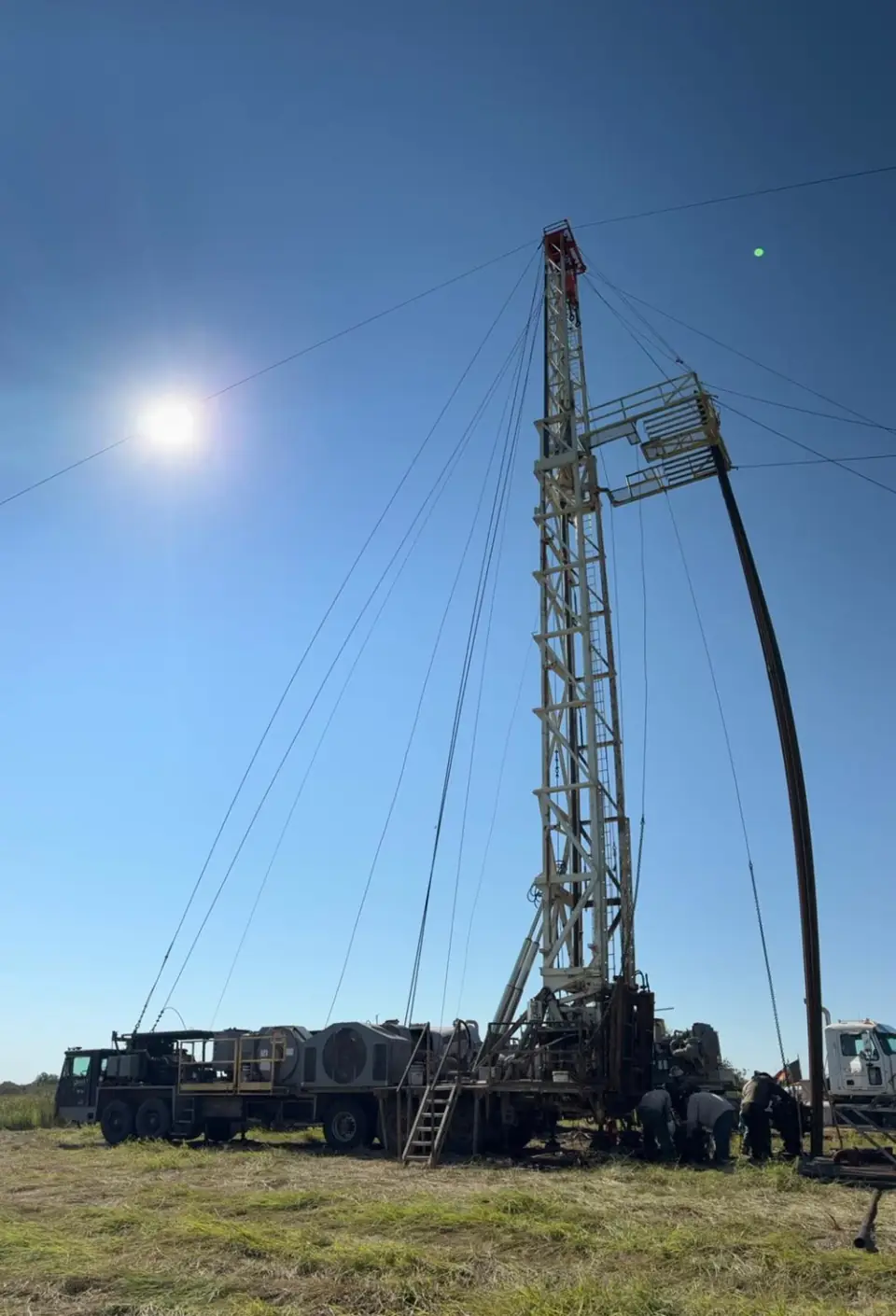
A carbon credit for plugging a leaking well is a claim about the future: had the well stayed open, it would have kept venting for years. We measure the leak as found, so we know its rate today with some care. Whether it would keep going is a different question, and the usual worry behind it is a fair one: that the gas feeding the leak is a closed pocket that will bleed out on its own.
This note works through that worry with physics and the public record, and it says where our own evidence stops.
The leak is a choke and the reservoir is a tank
How a leak behaves over time is decided at the top of the well and at the bottom, and the two are easy to run together.
The first is the failure itself: a corroded casing head, a cracked fitting, cement that no longer seals. Gas has to squeeze through it, and that narrow path is a choke. Its size and the pressure behind it set the rate. Through a hole in a fitting the rate rises roughly in step with that pressure; through a crack or poor cement it rises closer to the square of it. Either way, a narrow choke keeps the rate small however much gas sits below.
The second is the gas-bearing rock the well was drilled into, which behaves like a tank. Its size and its pressure set how long the leak can be fed. As gas leaves a closed tank its pressure falls, and the leak slows with it.

The choke tells you the rate today and the tank tells you how long. A measurement at the wellhead, however careful, describes only the choke.
The leak against what the well already gave
Most of the leaking wells we have measured in Oklahoma once produced gas for sale, and the state's records hold how much. That gives a first, rough sense of the tank's size. Take the 31 Oklahoma leaking wells we measured whose records show at least 10,000 thousand cubic feet (MCF) of production. Twenty years of leaking at the measured rate, held flat, comes to a median of about 7% of the gas each well already produced. The middle half of those wells fall between about 2% and 12%, and none comes to half.
Rates tell the same story from another side. On the 24 of our measured Oklahoma leaking wells with a monthly production series, the leak is a median of about 1.2% of the well's own peak producing rate.
Those numbers come with caveats. Produced gas tells you what the well once reached, not what is left. And against the rate a well was making in its final months of sales, the leak is not small: a median of about 0.3 of it, and above it on 6 of those 24 wells. The difference lies in why a well stops selling gas: it stops when it can no longer push into a sales line against that line's pressure and pay its way. A leak vents to open air, with no back-pressure and no point at which it stops paying, so it can keep drawing on gas a sales line could no longer take.
So the leak is small against the tank's history. The question is how much of the tank is left.
The answer swings on the abandonment pressure
For a closed gas tank, the gas left is set by the pressure left. The engineer's question is how far down the leak can draw it: the abandonment pressure, below which gas no longer comes out. For a well selling into a pipeline, the pipeline sets that level. For a leak to open air it sits much lower, and as far as we know it has not been measured on a leaking orphaned well. When we work through the arithmetic on our own wells, whether the gas left covers twenty years of leaking depends more on that one assumed pressure than on anything else in the sum. The reading that would anchor it, today's pressure in the reservoir, does not exist for these wells.
Our own way of working is part of the reason. As-found measurement never opens the well: nothing is opened, turned or pressurised, and every valve stays closed, as described on How we work. That keeps the leak reading a reading of the leak, but it also means we have never put a gauge on a well's pressure, and we hold no gauge reading on any well we have measured. A well is opened once, by the plugging crew, on the day it is sealed.
What the public pressure record can and cannot say
In August we described a figure for how fast formation pressure falls in Oklahoma, drawn from the state's records of shut-in pressure tests, as a measured decline. On 6 October 2026, after re-auditing it, we withdrew it. The state's files list each test several times, and the figure was a median of trends across formation names, mostly from tests taken when wells were completed. That is a trend in public test data, not a measurement of how pressure falls in any well we would plug. What the public record does support is narrower: public records put Oklahoma formation-pressure trends in the low single digits.
What evidence would settle it
Production history alone cannot, and for most orphaned wells the record a decline-curve analysis needs is missing anyway; that is the subject of a companion note. What would settle the question for a given well is an estimate of the gas still connected to it, prepared and signed by a petroleum engineer, using whichever standard method the well's record supports: decline analysis where the production history is usable, material balance where production and pressure readings exist, and volumetrics from the rock where they do not. That estimate should then be checked against a pressure reading taken on plugging day, when the well is open anyway, with the reading that would undercut the estimate written down before the gauge goes on.
A couple of further things belong in that estimate. Where an active well produces from the same rock nearby, the tank is shared, and some of the gas we would count may be drawn away; the engineer's low case should allow for it. Where the leak comes through a casing failure rather than from the producing zone, the gas may come from shallower rock the production record says nothing about.
Where our evidence stops
We have done the arithmetic above as a desk screening across our measured Oklahoma wells. It is a desk exercise by our own analyst, not a petroleum engineer's assessment, and no engineer has reviewed it yet.
We also hold almost no direct evidence of leaks over time. Three wells have instrument readings on more than one date, and the widest gap between readings is 35 days. That shows those leaks were still there a month later; it says nothing about the next twenty years, and we do not stretch it to.
Admittedly, that leaves the question open for any single well. Our read is that the physics points the right way: a narrow choke on a tank that, at the median, has already given up many times what twenty years of leaking would take. Turning that read into evidence a registry can check takes an engineer's signature and a gauge on plugging day.